How Chinese USB Flash Drive Factories Master Speed-to-Market

In the global digital economy, time is not just money; it is market share, relevance, and survival. When a tech reviewer in Berlin, a student in São Paulo, or an office manager in Chicago clicks “order” on a batch of custom USB flash drives, an astonishing logistical symphony begins, often centered thousands of miles away. The expectation is near-instant fulfillment, a reality made possible by a highly evolved ecosystem in China that has transformed the production and delivery of consumer electronics from a weeks-long process into one measured in days. The question isn’t just how these factories manufacture quickly, but how they have engineered an entire supply chain to deliver globally with breathtaking speed. The answer lies in a deep dive into a world of vertical integration, digital logistics, and a culture of relentless efficiency.
The Foundation: Vertical Integration and Component Clusters
The journey of a flash drive begins long before the plastic is molded. Its core components the NAND flash memory chip, the controller, the PCB (printed circuit board), and the housing are the building blocks of speed. China usb flash drive factories are particularly those in massive electronics hubs like Shenzhen and Dongguan, rarely operate in isolation. They exist within dense, hyper-specialized industrial clusters.
A factory producing branded flash drives is often just the final assembly point in a tightly-knit network. Within a few miles, one can find specialists in precision injection molding for casings, PCB fabricators, and distributors sourcing NAND flash from major Korean and American manufacturers. This geographic consolidation eliminates traditional shipping delays for parts. Raw materials and components move between factories in hours, not weeks. This vertical integration, sometimes within a single corporate conglomerate, means decision-making is streamlined. There is no transcontinental negotiation for a different chip variant; a short meeting or a message within the same industrial zone can pivot production overnight to meet a new specification or urgent order.
The Manufacturing Sprint: Agile Production Lines and Standardization
Upon receiving an order, the factory floor switches from a potential state to a kinetic one with minimal friction. Modern production lines are modular and agile. For standard drive models, changeover times the period needed to retool a line for a different product are measured in minutes. Much of this agility comes from the clever use of standardization beneath a veneer of customization.
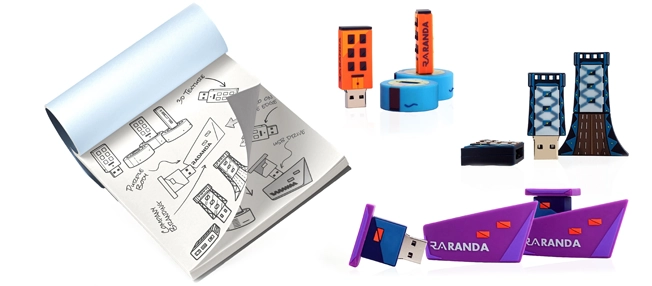
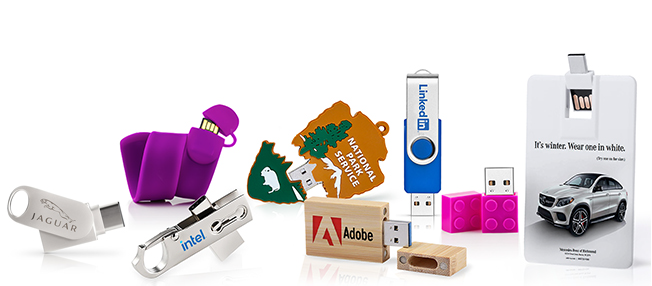
A client may order 10,000 drives with a unique logo, color, and pre-loaded content. To the factory, this is often a standard 32GB drive with a custom “skin” and a final software burn. The core assembly process soldering the NAND and controller onto the PCB remains identical across millions of units. The customization happens at the very end: a quick-change mold injects plastic in the client’s color, a laser etcher personalizes the logo in seconds, and an automated system loads the required files. This “late-stage differentiation” allows the factory to produce vast quantities of generic components in anticipation of demand, then apply the final, unique touches in a rapid, just-in-time manner.
Furthermore, many factories operate on a hybrid model. They maintain an inventory of their most popular standard models for immediate shipping, while the dedicated lines handle custom batch orders in continuous, overlapping cycles. This is supported by predictive algorithms that analyze order trends, ensuring that the most common NAND chip types and housing materials are never out of stock.
The Digital Nervous System: From Order to Invoice in Real-Time
Speed on the factory floor would be meaningless without equal speed in the front office. The entire process is managed by a seamless digital workflow. When an international order lands via the factory’s B2B portal, it instantly populates the Enterprise Resource Planning (ERP) system. This system automatically checks component inventory, schedules the production slot, generates pick lists for the warehouse, and assigns the job to a specific production line.
The client, meanwhile, has access to a dashboard. They can approve artwork proofs digitally, track the production status in near real-time (seeing updates like “Components Gathered,” “In Assembly,” “Quality Testing,” “Packaging”), and receive automated notifications. This transparency eliminates days of back-and-forth email communication and waiting for physical samples. Digital approvals accelerate the process at every stage, ensuring that the only thing moving is the product itself, not paperwork.
Logistics Alchemy: The Air, Sea, and Land Symphony
Once packaged, the drives face their greatest test: traversing the globe. This is where Chinese logistics prowess truly shines. Factories do not treat shipping as a separate, post-production step; it is an integrated component of their operation.
-
On-Site Consolidation and Forward Warehousing: Major factories have long-term partnerships with global logistics giants (DHL, FedEx, UPS) and freight forwarders. These partners often have offices or dedicated staff within the factory complex. As soon as a pallet is sealed and labeled, it is scanned into the courier’s system. For air freight, which is the standard for urgent, high-value, low-weight goods like flash drives, shipments are consolidated at on-site or nearby logistics hubs. They are whisked to megahubs like Hong Kong International Airport or Shenzhen Bao’an International Airport, which operate 24/7. Pre-cleared customs documentation, filed digitally as the pallet was built, means the cargo often bypasses lengthy checks and is loaded onto the next available flight.
-
The “Chequerboard” of Shipping Options: Factories are masters at selecting the optimal cost-speed trade-off for each client. They maintain a chequerboard of options:
-
Express Air (3-7 days): The default for samples and urgent orders.
-
Consolidated Air Freight (5-10 days): For larger batches, where the factory aggregates orders from multiple clients to fill a single air container, sharing the cost.
-
Hybrid Sea-Air (10-15 days): A sophisticated solution where cargo moves by sea to a regional hub like Dubai or Los Angeles, then completes its journey by air, offering significant savings over pure air freight with only a slight time penalty.
-
E-Packet & Special E-Commerce Lines (7-20 days): For direct-to-consumer smaller parcels, factories leverage China Post and discounted e-commerce agreements with national postal services worldwide.
-
This multi-modal flexibility ensures that “short period of time” is a relative term defined by the client’s budget, not the factory’s limitation.
The Human Element: A Culture of Urgency and Scale
Behind the machines and algorithms lies a human ecosystem calibrated for speed. The workforce in these hubs is accustomed to the “China speed” of manufacturing. Management structures are flat and decisive; night shifts are standard, keeping production lines humming 24 hours a day. The concept of a weekend slowdown is often alien; the production calendar operates in continuous cycles.
Moreover, the scale of operation creates its own velocity. Because a single factory might be producing drives for dozens of global brands simultaneously, every process from quality control checks to pallet wrapping—is performed with a rhythm and repetition that breeds incredible efficiency. Workers are specialists in minute tasks, achieving a speed and consistency that would be impossible in a lower-volume environment.
The Final Mile: Data and the Invisible Product
For USB flash drives, the journey isn’t always purely physical. A growing segment of the business involves drives pre-loaded with software, presentations, or marketing materials. Factories have streamlined this as well. Secure digital transfer portals allow clients to upload gigabyte-sized files directly to the factory’s servers. Automated loading stations then transfer the data to hundreds of drives simultaneously in a sealed, clean-room environment. This parallel processing—preparing the digital content while the physical drive is being assembled—saves crucial days.
Conclusion: The Anatomy of Modern Expectation
The ability of a Chinese USB flash drive factory to send a product across the world in a short period is not a single trick. It is the culmination of a holistic, systemic optimization of geography, supply chain, information technology, and human enterprise. It represents a mature manufacturing philosophy where time is the ultimate metric of waste.
They have compressed the traditional linear sequence of design-source-manufacture-ship into a concurrent, networked model. The factory is no longer just a production site; it is the nerve center of a rapid-response delivery system. This ecosystem does not simply meet the demand for speed; it actively constructs the modern consumer’s expectation of it. In a world accustomed to instant downloads, these factories have mastered the art of instant hardware, proving that even physical objects can, in the right system, move at the speed of thought.