How to Import USB Flash Drives from a Factory in China
Businesses are constantly looking for ways to cut costs while maintaining product quality, and importing directly from manufacturers has become a popular option. China, as the world’s largest manufacturing hub, offers a wide range of customizable products, including USB flash drives, at highly competitive prices. Whether you’re a tech company looking to expand your product line, a marketing firm in need of branded promotional items, or a business aiming to use custom USB drives as part of your branding efforts, importing from China can be a cost-effective solution.
However, the process of importing can be complex, particularly if you’re new to international trade. From finding a reliable manufacturer and negotiating prices to navigating customs regulations and handling shipping logistics, there are many steps that require careful attention to avoid costly mistakes. Importing involves dealing with time zones, language barriers, and compliance issues that can make or break your project. Yet, with the right approach and knowledge, these hurdles can be overcome smoothly.
In this guide, we will walk you through everything you need to know to successfully import USB flash drives from a factory in China. From sourcing reputable suppliers and negotiating terms to managing quality control and understanding customs procedures, we’ll provide you with actionable tips to ensure a seamless and successful importing process. By the end of this post, you’ll be equipped with the tools and insights necessary to make informed decisions and secure high-quality USB flash drives that meet your business needs.
USB flash drive china factory
Recommendation for How to Import USB Flash Drives from a Factory in China
Importing USB flash drives from China factory can be a smart business move, as Chinese manufacturers are known for offering competitive prices, customization options, and fast production times. However, the process of importing can seem daunting if you’re unfamiliar with international trade. In this post, we’ll walk you through the steps to successfully import USB flash drives from a Chinese factory.
1. Identify Reputable Manufacturers
Start by researching reputable USB flash drive manufacturers. Websites like Alibaba, Made-in-China, and Global Sources are great platforms to find verified suppliers. Look for suppliers with high ratings, positive reviews, and a track record of exporting internationally.
2. Request Samples
Before placing a bulk order, always request samples to inspect the quality of the USB flash drives. Check aspects such as storage capacity, speed, material, and customization options to ensure they meet your expectations.
3. Negotiate Terms and Prices
Chinese suppliers are usually open to negotiation, especially for large orders. Discuss pricing, minimum order quantities (MOQ), production times, and payment terms. You might also want to negotiate warranties and quality guarantees to protect your investment.
4. Understand Customs and Import Regulations
Importing from China involves dealing with customs and adhering to your country’s import regulations. Research any duties, taxes, or regulations specific to electronic products like USB flash drives. Working with a customs broker can help ensure compliance with these laws.
5. Choose the Right Shipping Method
Shipping options vary from air freight to sea freight. Air freight is faster but more expensive, while sea freight is cost-effective for larger orders but slower. Discuss with your supplier the best shipping method based on your order size and urgency.
6. Handle Quality Control
Once your USB flash drives are produced, it’s essential to ensure they meet your quality standards before they are shipped. You can hire third-party inspection services in China to verify the quality and consistency of the products.
7. Arrange Payment
Most Chinese manufacturers accept payments through methods such as wire transfers, PayPal, or escrow services for safety. Be cautious about paying the full amount upfront; it’s standard practice to pay a deposit (usually 30%) and the remaining balance after production is completed.
8. Monitor Shipping and Delivery
Once your order is shipped, track its progress to ensure it arrives on time. Be prepared to deal with any potential delays at customs or during transport. Having a reliable freight forwarder can help smooth the process.
Conclusion and finals comments
Importing USB flash drives from a factory in China offers a wealth of opportunities for businesses seeking to reduce costs, customize products, and stay competitive in the global market. With China being a leading supplier of tech products, the combination of advanced manufacturing capabilities, extensive customization options, and cost-effectiveness can significantly enhance your product offerings or marketing strategies. Whether you are ordering in bulk for retail or looking to distribute promotional items at events, USB flash drives remain a versatile and highly demanded product.
However, as with any international trade venture, successful importing requires careful planning, research, and a clear understanding of the process. It’s important to remember that the key to a smooth and profitable experience is in the details. From selecting the right manufacturer and negotiating favorable terms to ensuring quality control and adhering to shipping and customs regulations, each step plays a crucial role in ensuring that your investment yields positive results.
One of the most significant advantages of importing from China is the potential for customization. Chinese manufacturers often offer a wide array of design, material, and packaging options, allowing you to create a product that aligns with your brand identity or campaign objectives. This level of flexibility enables you to stand out in a crowded market, providing your clients or customers with something unique and memorable.
That being said, the process is not without its challenges. Language barriers, differences in business culture, and the intricacies of international logistics can be difficult to navigate without proper preparation. It is crucial to build strong communication with your suppliers, clearly outline your expectations, and verify product quality through samples or third-party inspection services. Additionally, understanding import regulations, tariffs, and shipping methods can save you from unexpected delays or extra costs.
Ultimately, importing USB flash drives from China can be a highly rewarding endeavor if approached with diligence and strategic planning. By following the steps outlined in this guide—researching reliable suppliers, managing quality control, negotiating favorable deals, and ensuring compliance with local regulations you can streamline the process and avoid common pitfalls. With the right partnerships and practices in place, importing USB flash drives will not only expand your product offerings but also strengthen your brand presence and boost profitability.
Now is the time to leverage the benefits of global trade and tap into the vast resources available in China’s manufacturing sector. By embracing this opportunity, your business can access high-quality products at competitive prices, gain greater control over customization, and unlock new possibilities for growth. Whether you’re a seasoned importer or a first-timer, the insights gained from this process will equip you with valuable skills for future sourcing efforts.

The History of the Creation of USB Flash Drives
From floppy disks to external hard drives, the evolution has been constant. However, the creation of the USB drive marked a before and after in how we carry and share data. Over the years, USB drives have evolved not only in terms of capacity and speed but also in their design and customization, becoming essential tools for both individual users and businesses.
The First Steps: The Invention of the USB Drive
The birth of the USB drive, also known as a flash drive, has its roots in the 1990s. The idea of creating a small, portable device capable of storing large amounts of data emerged as a necessity in a world that was generating more and more information. In 1999, the Israeli company M-Systems, led by Dov Moran, developed what is considered the first USB drive. This small device used flash memory to store data, making it much faster and more reliable than floppy disks, which were the standard at the time.
The first USB drive, called “DiskOnKey,” was launched in 2000 with a capacity of 8 MB, a quantity that today would seem insignificant but was revolutionary at the time. The creation of the USB drive represented a significant improvement compared to floppy disks, not only because of its storage capacity but also because of its durability, as it had no moving parts that could wear out with use.
The Evolution of USB Drives: Capacity and Design
Over time, USB drive technology continued to evolve. Storage capacity grew exponentially, from the initial 8 MB to several terabytes in today’s most advanced models. Additionally, data transfer speeds improved drastically thanks to the evolution of USB interfaces, from USB 1.0 to the current USB 3.2 and USB-C.
Parallel to these technical advancements, USB drives began to diversify in terms of design. At first, the devices were fairly standard and uniform in appearance, but soon companies saw the opportunity to use USB drives as marketing tools. Thus, custom USB drives were born.
The Era of Custom USB Drives: Innovation and Marketing
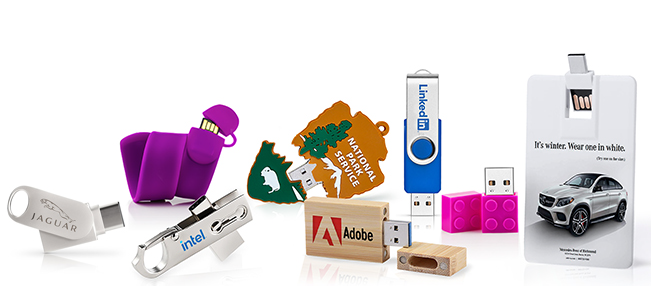
Customization of USB drives began as a simple addition of company logos on the device casing, but it quickly became an industry in itself. USB drives started being manufactured in an almost infinite variety of shapes, colors, and materials. From character figures to product replicas, custom USB drives became a creative way to represent a brand or concept.
Companies discovered that custom USB drives were an excellent promotional tool. Unlike other marketing items like pens or mugs, USB drives offered real value to the user, as they could be used to store and transfer data. Moreover, their compact size and the ability to customize them creatively made them very attractive for advertising campaigns, corporate gifts, and promotional events.
Customization as a Reflection of Identity
Beyond corporate use, custom USB drives also found a market among individual users. The possibility of having a storage device that reflected the user’s personality, tastes, or interests became an additional attraction. Thus, themed USB drives emerged, ranging from popular movie and TV characters to designs alluding to specific hobbies like music, sports, or video games.
Custom USB drives also began to be used at special events like weddings, birthdays, and conferences. Instead of traditional keepsakes, event organizers opted to give custom USB drives containing photos, videos, or presentations related to the occasion. This trend has grown over the years, demonstrating that custom USB drives are not only useful but also a means of expression and commemoration.
The Future of Custom USB Drives
Despite the rise of cloud storage services, China USB flash drives factory remain popular due to their simplicity, portability, and the security they offer by not relying on an internet connection. Additionally, the trend toward customization shows no signs of slowing down.
In the future, we are likely to see USB drives with even more advanced technologies, such as the integration of biometric security features, larger storage capacities, and even faster data transfer speeds. Moreover, customization will continue to evolve, with the possibility of incorporating technologies like 3D printing to create even more unique and personalized designs.
Conclusion
The history of custom USB drives is a reflection of how technology can adapt and evolve to meet the changing needs of users. From their humble beginnings as simple storage devices, USB drives have become essential tools in daily life, while also offering a creative and personal way to express identity and brand. As technology advances, we can only imagine what new forms these small but powerful devices will take in the future.